
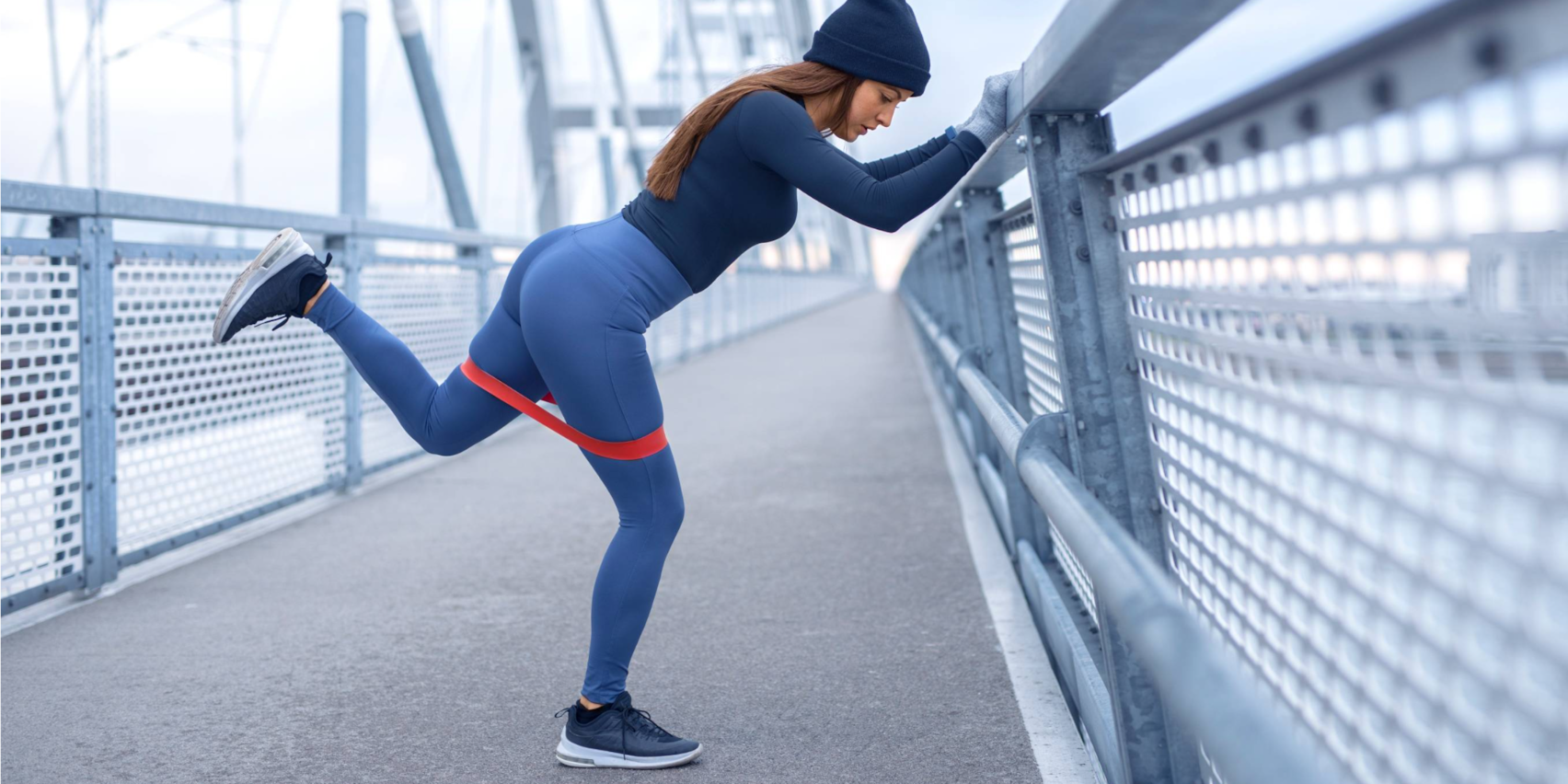
Strong bum, strong back – why your glutes are more important than you think

4.2.2026
Translation: Megan Cornish
Prolonged sitting weakens the gluteal muscles and puts strain on your lower back. Studies show why having strong buttocks can help. Here’s our round-up of the exercises you need.
«No big deal,» you might think. «It’s just a cosmetic issue – I don’t need a perky bum.» But it’s about much more than just looking the part. Your three gluteal muscles (gluteus maximus, medius and minimus) stabilise your hips and pelvis, supporting lumbopelvic control (how well your back, pelvis and hips work together during movement). This trio of muscles provides strength, control and proper alignment for all lower body movements. If they’re weak, your lower back suffers.
How your pelvis becomes unbalanced and the consequences
Think of your pelvis like a bridge. Your gluteal muscles are the supports. If they’re strong, the load’s distributed evenly – and your back can relax. Your body works as it should.
Prolonged sitting can cause an imbalance. Your gluteal muscles get weaker, while the muscles at the front of your hips shorten and tighten. This can contribute to your pelvis tilting forward. To compensate, some people develop a more pronounced curve in their lower spine, where different forces are exerted on the lumbar vertebrae with every step. Your body tries to compensate for the imbalance by engaging other muscles. This puts more strain on your lower back, hamstrings and hips. Back pain can have many causes – this is one of them.
Buttock exercises to combat back pain
But there’s good news too. Several studies show that targeted training of the gluteal muscles can help combat restricted movement and pain.
A Japanese study from 2015 showed that people who trained their gluteal muscles in addition to standard back training improved significantly more than the comparison group without additional glute training.
Researchers from Egypt also observed significant differences in 2024. Specific gluteal muscle training reduced pain more effectively than the standard programme. In a test assessing how well participants could squat on one leg (a sign of true functionality), the glute training group performed significantly better, with a 59 per cent improvement compared to 21 per cent in the standard training group.
Another study from 2024 examined combining gluteal muscle training with core stabilisation. Participants who specifically trained their gluteal muscles not only had less back pain, they also regained confidence and reported a higher quality of life.
Three easy exercises from the research
If all this is making you think, here are three specific exercises to strengthen your gluteal muscles.
Physiotherapist Dr Tom Walters analysed the research and shows how to do the exercises correctly step by step on his YouTube channel Rehab Science:
1. Hip raises Support yourself on your forearms, keep both knees on the ground, then lift one leg until your thigh’s parallel to the floor. Repeat ten times with each leg.
2. Clamshells Lie on your side, stack your one leg on top of the other, then open your top knee upwards as if you were opening a shell. Again, do ten repetitions on each side.
3. Single-leg bridges Lie on your back with one leg on the floor and the other extended upwards. Push your hips upwards until your body forms a straight line. Repeat ten times on each side. If this last exercise is too intense at first, you can start with a standard two-legged bridge until you can perform the single version without pain.
Note: This article refers to non-specific, chronic back pain. The studies mentioned can’t be automatically applied to every type of back pain. If you experience any pain radiating into the leg, numbness, loss of strength or develop bladder or bowel problems, consult a doctor as a priority. The exercises shouldn’t worsen symptoms. If your symptoms worsen significantly or you experience new symptoms, stop and seek medical advice.


Anna Sandner
Senior Editor
Anna.Sandner@galaxus.deScience editor and biologist. I love animals and am fascinated by plants, their abilities and everything you can do with them. That's why my favourite place is always the outdoors - somewhere in nature, preferably in my wild garden.
Health
Follow topics and stay updated on your areas of interest
Fitness
Follow topics and stay updated on your areas of interest
Sport
Follow topics and stay updated on your areas of interest
Background information
Interesting facts about products, behind-the-scenes looks at manufacturers and deep-dives on interesting people.
Show allThese articles might also interest you
Show all


These articles might also interest you


15 comments
later