Responsive styling and viewport dependant JavaScript.
Prefer CSS media queries. CSS applies during server-side rendering, while
matchMedia only works in the browser. Rendering different markup per screen
range in JavaScript causes hydration errors or layout shifts.
#Screen Ranges
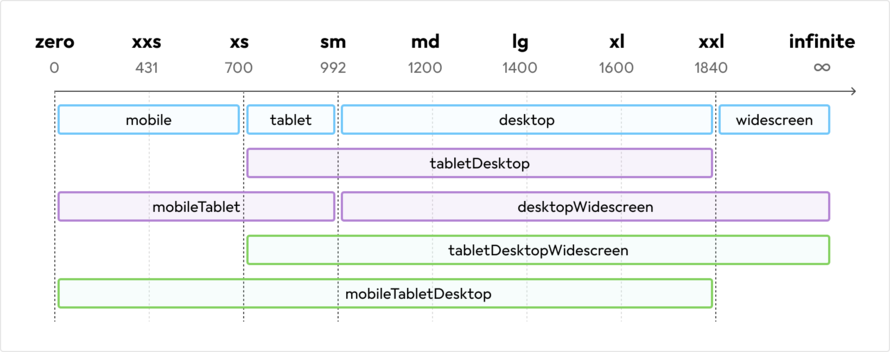
These ranges represent the most common ones we use for responsive design.
#Screen Range Media Queries
Media queries for CSS that is only applied within. All range names are inclusive, for example mobileTabletDesktop means mobile and tablet and desktop.
| Query | range start | range end |
|---|---|---|
screenRangeQueries.mobile | 0px | 699px |
screenRangeQueries.tablet | 700px | 991px |
screenRangeQueries.desktop | 992px | 1839px |
screenRangeQueries.widescreen | 1840px | Infinity |
screenRangeQueries.mobileTablet | 0px | 991px |
screenRangeQueries.tabletDesktop | 700px | 1839px |
screenRangeQueries.desktopWidescreen | 992px | Infinity |
screenRangeQueries.mobileTabletDesktop | 0px | 1839px |
screenRangeQueries.tabletDesktopWidescreen | 700px | Infinity |
import { screenRangeQueries } from "@blocks/theme";

const ExampleComponent = styled.div`
  /* mobile first */
  background-color: green;

  /* 992px to Infinity */
  ${screenRangeQueries.desktopWidescreen} {
    background-color: purple;
  }
`;
#Reading the Screen Range in JavaScript
isScreenRange and isMediaQuery return whether a query matches at the moment they are called. Use them where the value is read on demand: event handlers, tracking, or effects triggered by something else. They need no hook, state or listener, and return false during SSR.
isMediaQuery accepts a plain condition or a query from screenRangeQueries / breakpointRangeQueries.
import {
  breakpointRangeQueries,
  isMediaQuery,
  isScreenRange,
} from "@blocks/theme";

const handleClick = () => {
  if (isScreenRange("mobile")) {
    scrollToPosition(0, savedScrollY);
  }
};

const handleImpression = () => {
  track({ columnCount: isMediaQuery(breakpointRangeQueries["md-*"]) ? 3 : 2 });
};

const handlePointerUp = () => {
  if (!isMediaQuery("(prefers-reduced-motion: reduce)")) {
    startMomentumScroll();
  }
};
Don't use them for render output. They return false on the server, so the first client render can differ from the server markup.
#Screen Range Effect Hook
The useScreenRangeEffect runs JavaScript when a screen range starts or stops matching, for example to close a menu when the viewport leaves mobileTablet. Use with caution: setting state in the callback re-renders the component.
Callback arguments
isInRangeistrueandfalseaccording to matching the rangereasonshows the phase of when it was matched, "mount" or "change"
import { useScreenRangeEffect } from "@blocks/theme";

const Component = () => {
  useScreenRangeEffect(
    "mobileTablet", // screen range name
    (isInRange) => {
      if (!isInRange) {
        closeMobileMenu();
      }
    },
    [],
  );
};
Hint: For touch and mouse distinction, consider using useDeviceEffect().
#Breakpoints
Breakpoint values are accessible via breakpoints object from @blocks/theme.
| Breakpoint | viewport width |
|---|---|
| xxs | 450px |
| xs | 700px |
| sm | 992px |
| md | 1200px |
| lg | 1400px |
| xl | 1600px |
| xxl | 1840px |
#Breakpoint Media Queries
Use screenRangeQueries whenever possible, breakpointRangeQueries are for special cases where the ranges are not flexible enough.
// try to use screenRangeQueries whenever possible.
import { breakpointRangeQueries } from "@blocks/theme";

const ExampleComponent = styled.div`
  background-color: green;

  /* from 0px to 1199px */
  ${breakpointRangeQueries["*-md"]} {
    background-color: red;
  }
`;
#Syntax of the breakpoint queries
Wildcard based open boundaries.
| Query | range start | range end | description |
|---|---|---|---|
breakpointRangeQueries["xs-md"] | 700px | 1199px | everything between xs (inclusive)up to the md breakpoint (exclusive) |
breakpointRangeQueries["*-md"] | 0px | 1199px | everything from zero up to the md breakpoint (exclusive) |
breakpointRangeQueries["md-*"] | 1200px | Infinity | everything from md (inclusive) to Infinity |
#Breakpoint Range Effects
The useBreakpointRangeEffect hook is a simple way to listen to the breakpoint changes in JavaScript.
The callback arguments
isInRangeistrueandfalseaccording to matching the rangereasonshows the phase of when it was matched, "mount" or "change"
For more flexibility, consider using useMediaQueryEffect() instead.
import { useBreakpointRangeEffect } from "@blocks/theme";
import { useState } from "react";

const Component = () => {
  const [inRange, setInRange] = useState(false);

  useBreakpointRangeEffect(
    "md-*", // breakpoint range query key
    (isInRange, reason) => {
      setInRange(isInRange);
    },
    [],
  );
};
#Media Query Effect Hook
The useMediaQueryEffect hook is a more flexible way to listen to the media query changes in JavaScript.
It leverages the window.matchMedia API under the hood: MDN matchMedia.
import { useMediaQueryEffect } from "@blocks/theme";
import { useState } from "react";

const Component = () => {
  const [isLandscape, setIsLandscape] = useState(false);

  useMediaQueryEffect(
    "(orientation: landscape)", // media query
    (queryDidMatch) => {
      setIsLandscape(queryDidMatch);
    },
    [],
  );
};

const CustomQueryComponent = () => {
  // You can also use this hook to build custom screen range queries
  const [inRange, setInRange] = useState(false);

  // 992px - 1199px, without the "@media" prefix
  const customScreenRangeQuery = `(min-width: ${breakpoints.sm}px) and (max-width: ${breakpoints.md - 1}px)`;
  useMediaQueryEffect(customScreenRangeQuery, (queryDidMatch) =>
    setInRange(queryDidMatch),
  );
};